An Eid greeting that opens like an Eidiya envelope
The Dawaitna Team · 2026-11-07
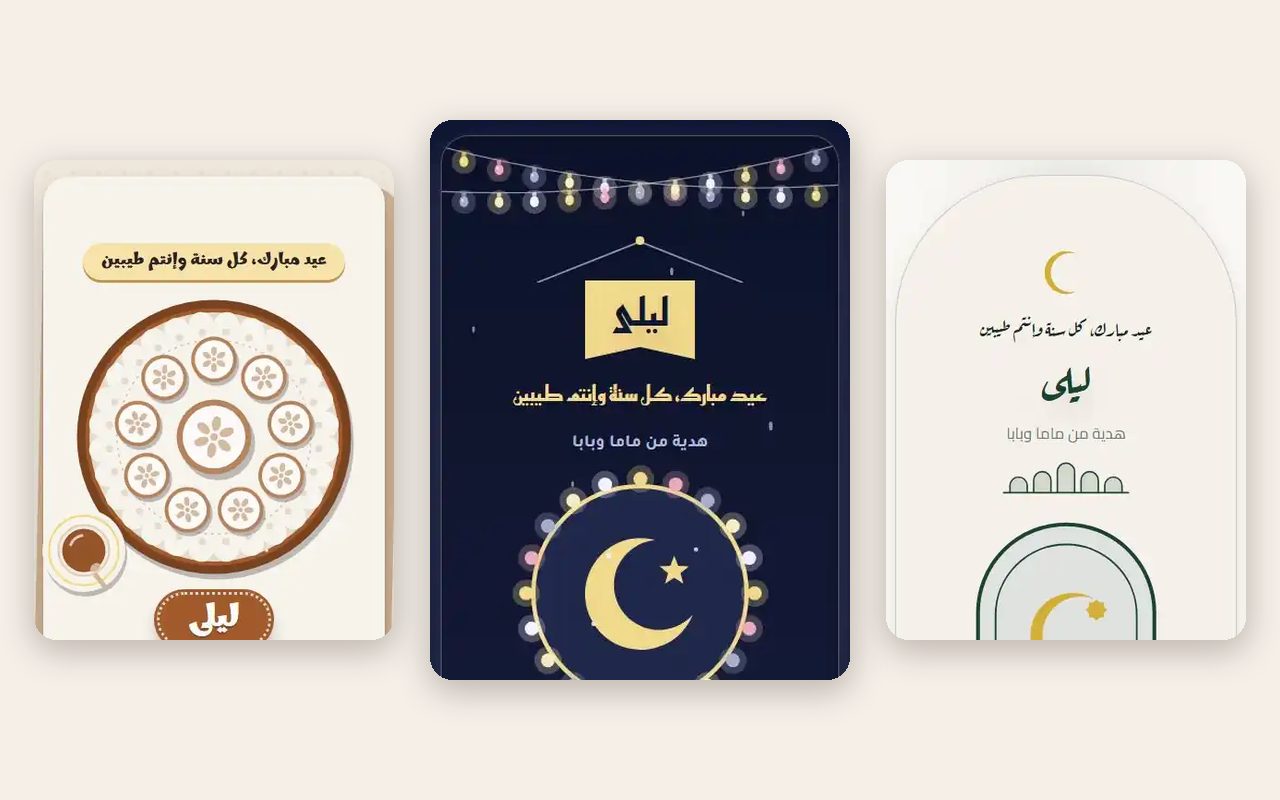
An Eid greeting is usually an image forwarded to forty people. This is a page that opens, with the name of the family it is for at the top.
Designs
Three designs, each with three palettes and three fonts.
Kahk is a tray of kahk with icing sugar in warm bakery colours. Street lights is strings of coloured bulbs between balconies. Takbeer is white and green with calm Arabic calligraphy.
Kahk is the one that makes people smile first. Takbeer is the choice for a greeting to someone older, or to a family that likes things quiet.
In colours, Kahk comes in Sand, Coral and Kraft; Street lights comes in Navy, Obsidian gold and Plum; Takbeer comes in Royal emerald, Ivory and Emerald. The fonts are your choice too: Kahk has Marhey, Lalezar and Cairo, and the other designs have three of their own. You can also set the text size to smaller, normal or larger.
How it opens
You choose among three openers, and the first is the default.
- Eidiya envelope. They tap the envelope and the Eidiya card slides out.
- Lantern. They tap the lantern to light it.
- Gift box. They pull the ribbon and the box opens.
The Eidiya envelope fits the occasion better than anything else, and children understand it at once. There is no money inside the envelope, only the greeting, so tell the children before they ask.
What to write
An Eid page is the lightest of the digital cards. The form asks who the greeting is for, which can be a name or a family, and the day. That is all. If you want to add something, you can write your own line under the greeting, and the page has a short stock one: "Eid Mubarak. Many happy returns."
Because it is a short page, the wording carries it. A few ideas that work:
- Put the family name in, not "dear all". "Eid Mubarak to the Hassan family" reads like it was written for them.
- Say one thing that is true of this year: a first Eid in a new house, an Eid with the new baby.
- Keep it to a line or two. The envelope does the rest.
Before you send it
Send it in the morning, before the visits start, so it arrives while people are still at home and phones are in hand. If the family is large, make one page per household instead of one for everybody, so each page can carry a family name. The link is the same length either way.
The link goes out on WhatsApp like any other. Whoever taps it sees the page open in the phone browser, with nothing to install and no account to make.
Making one
Open the Eid pages, try the three designs and choose the colours. You build and preview before paying. After you publish, the page is open to anyone with the link for 24 hours free, and then it needs a one-time payment by Instapay or a mobile wallet. The price is on the occasion page.
The form asks what day you will give the card. You can edit until that day or for 72 hours after you first publish, whichever is sooner. Then the page keeps running and is closed to changes. We can reopen it if you ask.
If you want to send it to relatives abroad, the page also has an English version.