A Ramadan greeting with a lantern that lights up
The Dawaitna Team · 2026-11-09
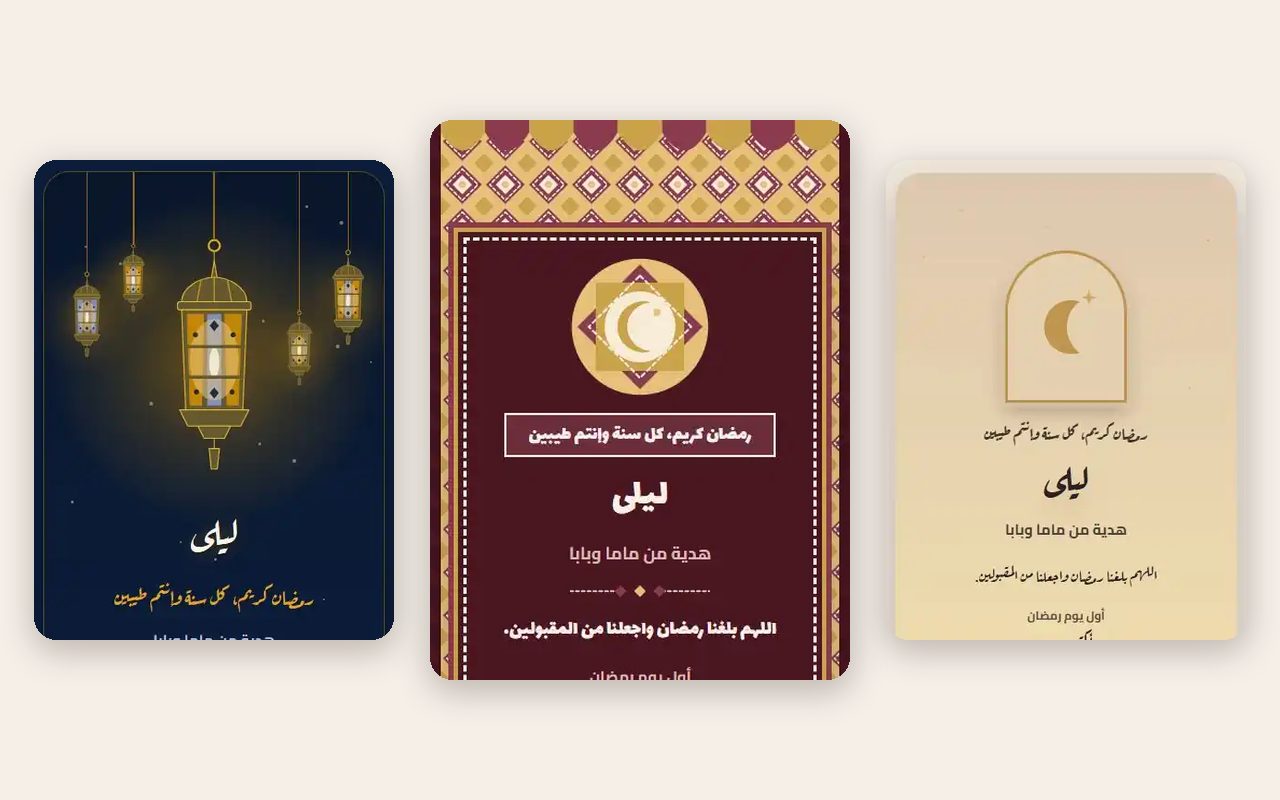
The first night of Ramadan has its own kind of messages: the same graphic from every contact. A page with a lantern the person lights themselves is a small way to be different.
Designs
Three designs, each with three palettes and three fonts.
Fanous is a coloured glass lantern glowing in the Ramadan night. Khayamiya is the red and blue appliqué pattern of Ramadan tents. Crescent over rooftops is a crescent, minarets and rooftops at sunset.
Fanous is the most direct. Khayamiya is for anyone who grew up with the tents and the street decorations, and it is the busiest. The crescent is calm and works well for older relatives.
In colours, Fanous comes in Indigo brass, Navy and Emerald; Khayamiya comes in Burgundy, Nubian and Indigo brass; Crescent over rooftops comes in Sand, Gold and Night. The fonts are your choice too: Fanous has Ruqaa, Amiri and Kufi, and the other designs have three of their own. You can also set the text size to smaller, normal or larger.
How it opens
Only two openers, because the page is meant to be quick.
- Lantern. They tap the lantern to light it. This is the default.
- Scroll. They tap or pull the scroll down.
The lantern is the one to pick. It is hard to improve on a lantern that lights when you touch it.
What to write
The form asks who the greeting is for, a name or a family, and the first day of Ramadan. The page starts with a wish already in place, such as "Ramadan Kareem. Wishing you a blessed month." You can keep it or write your own, and the stock prayers are there if you want one: "May Allah accept the fasting and the prayers."
Sections on the page are few: the opening, the countdown cover, and the music. A Ramadan page has no counter, so it does not show years or days. If you add a song, pick something quiet. A page that plays loudly at midnight is not a kindness.
A few things that work well:
- Name the person. "Ramadan Kareem, Aunt Samia" lands better than a general greeting.
- Mention one thing you look forward to together: the first iftar, the Taraweeh walk.
- Keep it short. Nobody reads a long text on the first night.
Before you send it
Pick the day you send it deliberately. A greeting that lands the evening before the first day feels thoughtful, and one that lands at the iftar rush gets buried. If you are sending several, put the person's name in each one and test one link on a phone with a poor connection, since the lantern should light quickly even on a slow network.
The link goes out on WhatsApp like any other. Whoever taps it sees the page open in the phone browser, with nothing to install and no account to make.
Making one
Look at the Ramadan pages, try the three designs and pick the colours. You build and preview the page before paying. When you publish, it is open to anyone with the link for 24 hours free, then it needs a one-time payment by Instapay or a mobile wallet. The occasion page shows the price.
The form asks which day you will give the card. You can edit until that day, or for 72 hours after you first publish, whichever is first. After that the page stays online and closes to editing, and we can reopen it if you ask.
There is an Arabic version and an English version of every page.