A 'who knows us best?' quiz inside your invitation
The Dawaitna Team · 2026-10-30
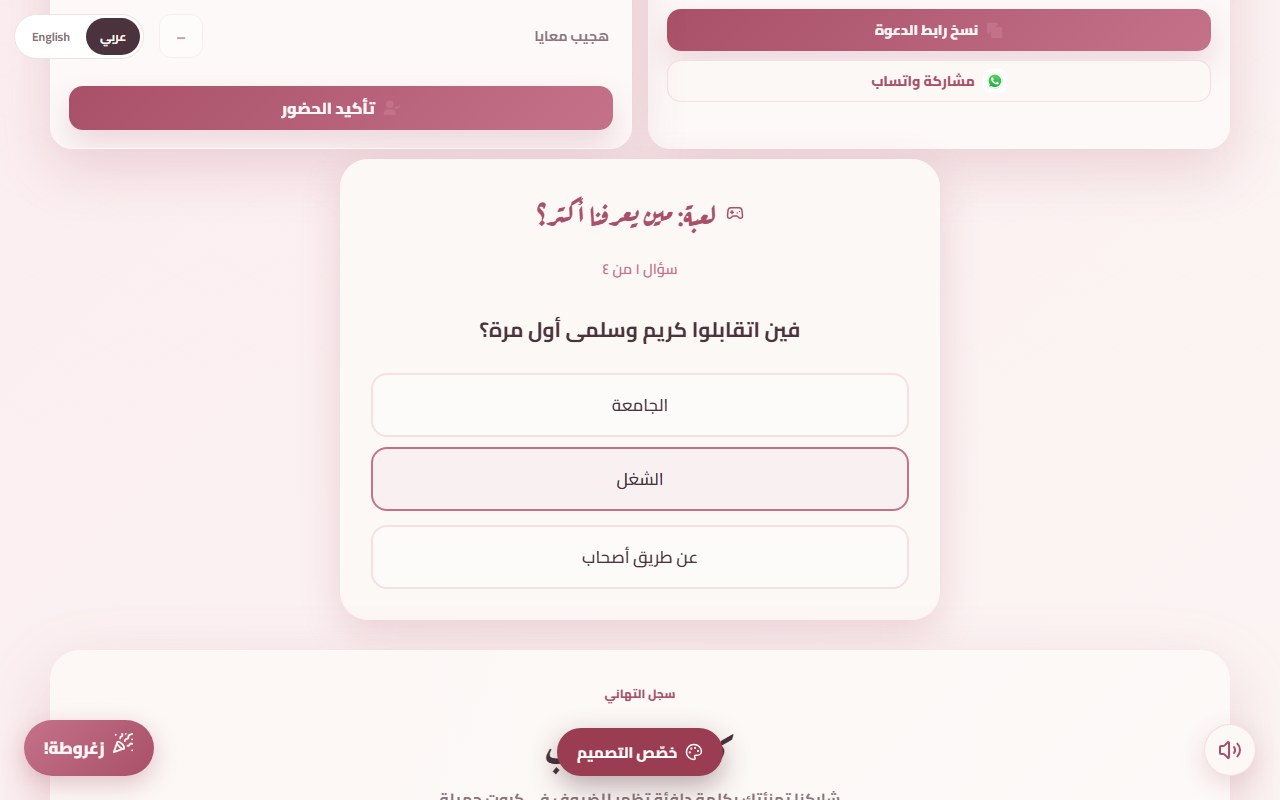
Most of an invitation is information: the date, the place, how to get there. The quiz is the one part that is only for fun, and a guest who opened the link to check the time will often stay for two more minutes.
How it works
The section is called "who knows us best?". A guest sees one question at a time with two or three answers and taps one. The page shows whether it was right, with a burst of confetti when it was, then moves to the next question. At the end the guest gets a score and one of three messages, from "you know every detail" down to "looks like we haven't met yet".
Nothing is recorded. The score lives on the guest's own screen, so nobody is ranked and nobody is embarrassed. Your aunt who scored zero will laugh and send the link to her cousin.
Who actually plays
The link travels through the family WhatsApp group, so the players are not only the people who will be in the hall. They include relatives in Saudi Arabia or the Gulf, university friends who can't come, and children holding their mother's phone. All of them can open the link and play without knowing anything about Instapay or the schedule. Expect the group to start arguing about answers: "I said university, how is it work?"
Writing questions that work
Short questions with one clear answer play best. A few that tend to work:
- Where did the two of you first meet?
- Who said "I love you" first?
- Which of you is always late?
- What was the first trip you took together?
- Which dish do you fight over?
Four or five questions are enough. After that the guest gets bored.
Common mistakes
A question nobody can answer. "What year did the groom get his licence?" Three people in the family will know. The rest will guess and feel they were tested on something that isn't theirs.
A question that embarrasses. Leave out old engagements and anything one of the two families would rather not mention. The quiz is for laughing.
Look-alike answers. If the choices are "Cairo", "Heliopolis" and "Nasr City", the guest is left to guess. Make the options clearly different, with one joke among them.
A long question. It will be read on a phone. One sentence.
The line after the answer
Each question can carry a short explanation that shows once the guest has answered. It is the place for the story behind the answer, in one sentence: "At a friend's wedding, and he spilled coffee on her dress." The line gives a wrong guess something to learn from, and gives a right one a smile.
Who checks the questions
Write the questions yourselves, then ask a friend or the bride's sister to answer without seeing the answers. If she gets one wrong, the question needs fixing. Then open the page on a phone from outside your family, and the preview shows you the real thing.
Where it sits
The quiz is one optional step in the editor. Write the questions and the section switches itself on. One of the designs, Storybook, is built around it and needs at least three questions. If you pick it on the start page, you write its questions on the same page that asks for the names, the date and the venue. The quiz stores nothing about guests, so it doesn't add to the price.
It also works on anniversary pages, where children write the questions about their parents.
You can play a four-question round on the demo invitation.